


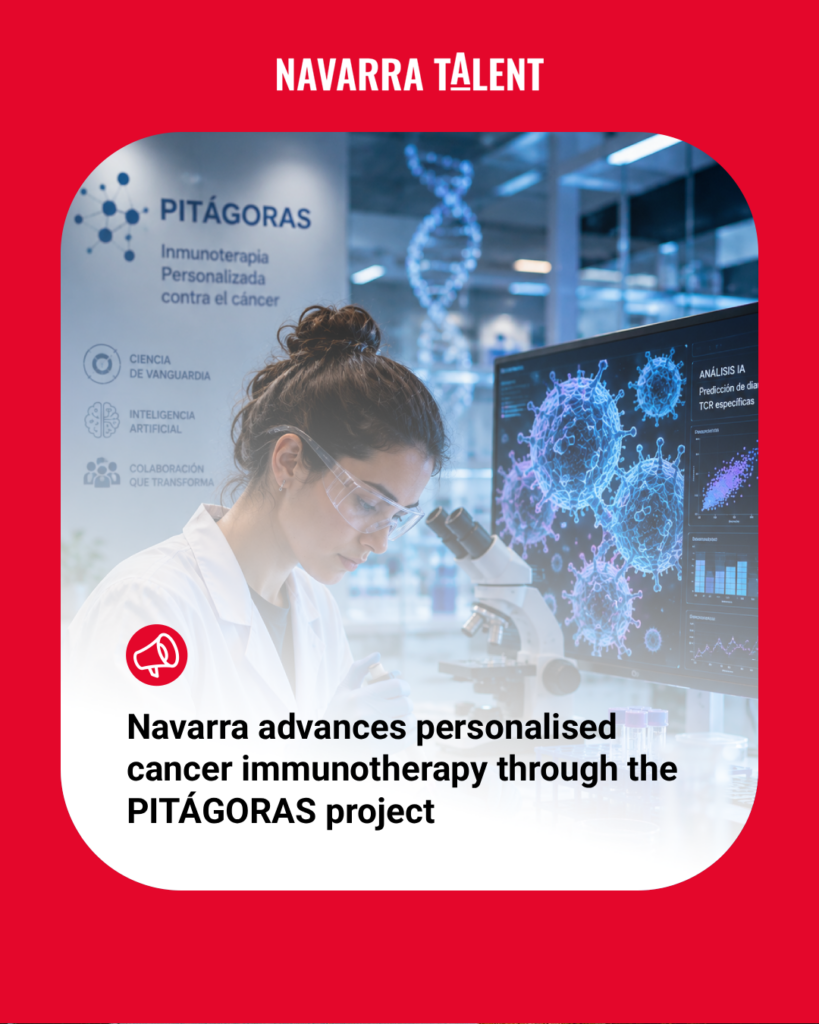
Navarra
continues to make progress in one of the most promising fields of future
medicine. The PITÁGORAS project has developed a scientific and
technological platform focused on personalised cancer immunotherapies, helping
bridge the gap between laboratory research and future clinical applications.
continues to make progress in one of the most promising fields of future
medicine. The PITÁGORAS project has developed a scientific and
technological platform focused on personalised cancer immunotherapies, helping
bridge the gap between laboratory research and future clinical applications.
By
combining advanced single-cell sequencing technologies with Artificial
Intelligence, researchers have successfully identified tumour-specific
T-cell receptors (TCRs). These receptors could be used to design personalised
cellular therapies that are more targeted and potentially offer new
possibilities for patients who currently have limited effective treatment
options.
combining advanced single-cell sequencing technologies with Artificial
Intelligence, researchers have successfully identified tumour-specific
T-cell receptors (TCRs). These receptors could be used to design personalised
cellular therapies that are more targeted and potentially offer new
possibilities for patients who currently have limited effective treatment
options.
One of the
project’s key achievements has been the detailed structural and biophysical
characterisation of a particularly promising TCR candidate, together with the
development of production protocols under GMP clinical standards. This
represents an important foundation for future clinical trials in humans.
project’s key achievements has been the detailed structural and biophysical
characterisation of a particularly promising TCR candidate, together with the
development of production protocols under GMP clinical standards. This
represents an important foundation for future clinical trials in humans.
PITÁGORAS
also showcases the strength of Navarra’s collaborative healthcare and
innovation ecosystem. The consortium brings together Cima Universidad de
Navarra, Navarrabiomed, Clínica Universidad de Navarra, Hospital Universitario
de Navarra, Nasertic, Aditech, 3P Biovian and Neuraraptic AI, connecting
scientific research, healthcare, technology and industry.
also showcases the strength of Navarra’s collaborative healthcare and
innovation ecosystem. The consortium brings together Cima Universidad de
Navarra, Navarrabiomed, Clínica Universidad de Navarra, Hospital Universitario
de Navarra, Nasertic, Aditech, 3P Biovian and Neuraraptic AI, connecting
scientific research, healthcare, technology and industry.
The project
received €1.6 million in funding from the Government of Navarra through
its 2023-2025 strategic projects programme and the GEMA challenge, focused on
personalised medicine and advanced therapies.
received €1.6 million in funding from the Government of Navarra through
its 2023-2025 strategic projects programme and the GEMA challenge, focused on
personalised medicine and advanced therapies.
The next
stage will involve validating the findings in new patient cohorts, improving AI
algorithms to increase the precision of tumour-specific TCR identification and
further optimising the most promising therapeutic candidates.
stage will involve validating the findings in new patient cohorts, improving AI
algorithms to increase the precision of tumour-specific TCR identification and
further optimising the most promising therapeutic candidates.
For
international professionals, projects like PITÁGORAS reveal another side of
Navarra: a place where scientific and technological talent can work on
innovation with real-world impact. Biotechnology, AI, biomedical research,
bioinformatics and advanced therapies are creating exciting opportunities for
professionals who want to help shape the future of medicine.
international professionals, projects like PITÁGORAS reveal another side of
Navarra: a place where scientific and technological talent can work on
innovation with real-world impact. Biotechnology, AI, biomedical research,
bioinformatics and advanced therapies are creating exciting opportunities for
professionals who want to help shape the future of medicine.


